
# The Second Roar of Tragedy: Urban Overpass Crumbles Again, Swallowing Rescuers in a Chilling Plume of Dust and Despair
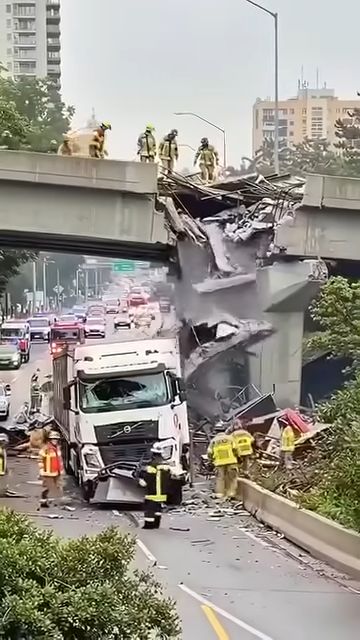
The air hung heavy with the grim promise of an overcast sky, mirroring the somber mood already gripping the multi-lane urban highway. What began as a catastrophic bridge collapse had swiftly escalated into a scene of utter devastation, its initial horror compounded by an unthinkable second act. Amidst the chaos, a white Volvo semi-truck lay mangled, its windshield a spiderweb of shattered glass, a testament to the brute force of concrete debris and twisted rebar that now littered the roadway.
Scores of first responders, their high-visibility gear a stark contrast to the muted tones of the industrial tragedy, moved with urgent purpose on the ground. Their presence spoke of lives saved, of immediate dangers contained, of the professional resolve that steps into the breach when disaster strikes. Above them, on what remained of the elevated overpass, more emergency personnel surveyed the wreckage, their figures silhouetted against the bruised sky, assessing the structural integrity, charting a course through the destruction. It was a precarious calm, a testament to human resilience in the face of immense destruction, yet beneath it, an unseen vulnerability simmered.
Then, without warning, the world tore itself apart again. With a seismic roar that drowned out all other sounds, a massive section of the overpass, seemingly stable moments before, began its descent. It wasn’t a gentle give; it was a violent, cataclysmic surrender to gravity. The structure buckled, groaned, and then plummeted downwards, unleashing a monstrous, suffocating plume of dust that instantly engulfed the entire scene. In a horrific tableau of unfathomable speed, several first responders, who had been observing from above, were caught in the collapse, sent hurtling downwards with the fracturing concrete and groaning steel. Their dramatic fall was a gut-wrenching visual, a chilling reminder of the indiscriminate nature of such a disaster.
Captured from a slightly elevated, almost vertical perspective, the sheer scale of the catastrophe was breathtakingly clear, yet agonizingly close. The sounds were as brutal as the visuals: the initial grinding, tearing violence of the bridge giving way, a symphony of destruction that climaxed with a distinct, high-pitched human scream piercing through the cacophony. It was a sound that etched itself into the very fabric of the moment – a cry of shock, of terror, of the sudden, brutal realization of mortality. It was the sound of humanity’s fragility exposed, of the unexpected turning utterly, irrevocably tragic.
In the aftermath of the second, unforgivable collapse, the dust slowly began to settle, revealing a scene even more horrific than before. What started as an accident had spiraled into a double tragedy, claiming not just infrastructure, but the very heroes who had rushed to save others. The immediate questions would be numerous, the investigations exhaustive, but in that moment, all that lingered was the heavy silence that followed the roar, a testament to the lives irrevocably altered and the somber realization that even those who run towards danger are not immune when the very ground beneath them gives way.